 ◎ 图解:秩决定了空间的“厚度”,而打洞技巧则是我们解剖庞然大物的手术刀
秩 (Rank):信息的含金量
在教科书里,秩的定义枯燥得要命:“矩阵中非零子式的最高阶数”。 哪怕你会算秩,你可能还是不明白:为什么我们这么在乎这个数字?
想象你有一张 $1000 \times 1000$ 的高清图片(也就是一个百万像素的矩阵 $\mathbf{A}$)。
- 情况 A:这是一张白噪声图(像老式电视机的雪花屏)。此时,矩阵大概率是满秩的 ($r=1000$)。你需要存储所有 100 万个数据点,少一个都不行,因为每个点都是独立的随机信息。
- 情况 B:这是一张纯红色的图。虽然它还是 $1000 \times 1000$,但它的秩 $r=1$。为什么?因为所有的列向量都是线性相关的(长得都一样)。你只需要存一个像素值,然后说“把它复制 100 万遍”。
直觉结论:
秩 (Rank) 代表了矩阵中“独立信息”的维度。 秩越小,数据越冗余,越容易被压缩。
核心绝技:打洞原理 (The Hole-Punching Principle)
如果说分块矩阵是“宏观视角”,那么打洞 (Hole-Punching) 就是在这个视角下进行的“精确手术”。
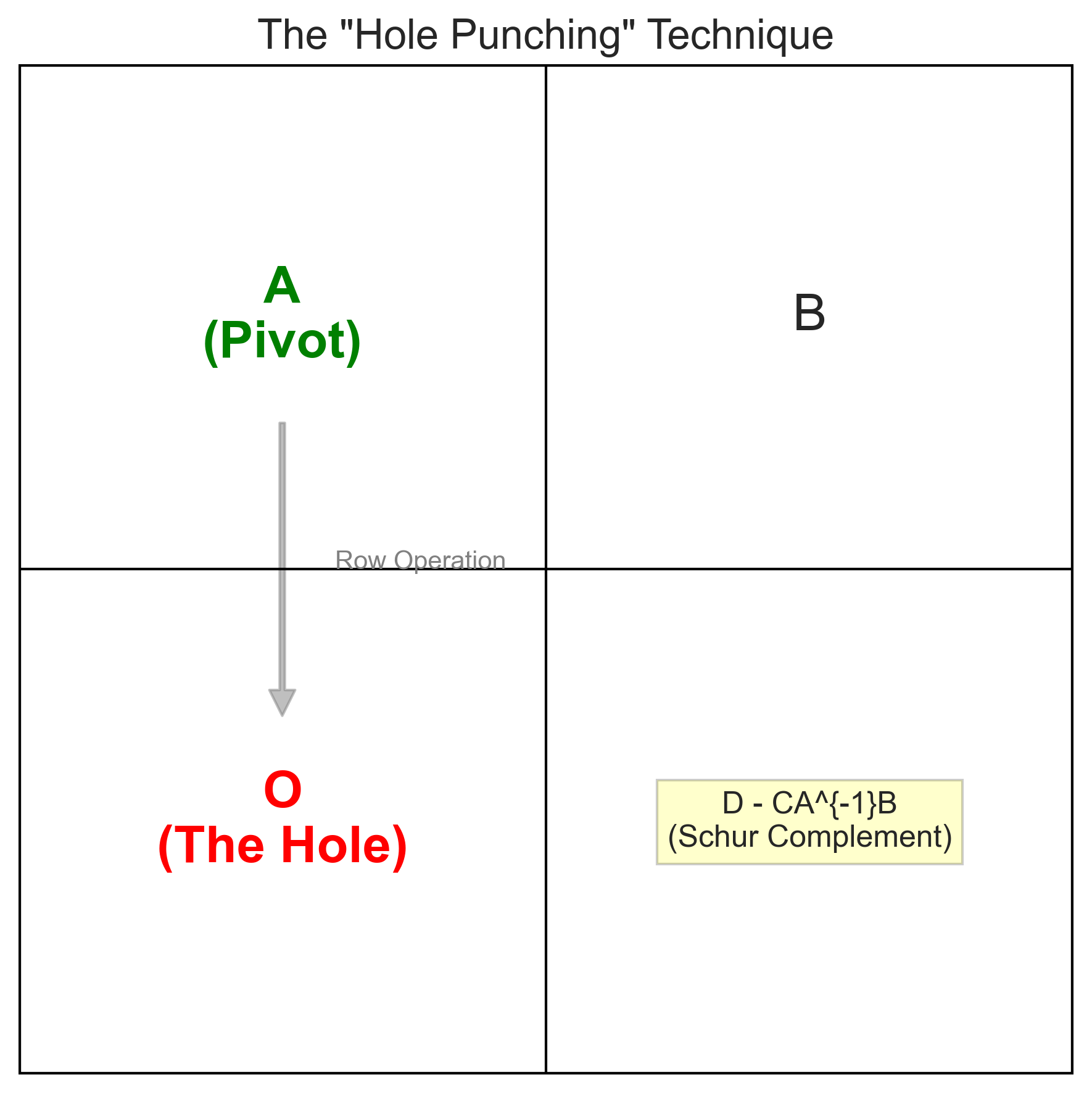 ◎ 打洞:将分块消为零块
1. 什么是“打洞”?
设有一个分块矩阵 $\mathbf{M} = \begin{pmatrix} \mathbf{A} & \mathbf{B} \\ \mathbf{C} & \mathbf{D} \end{pmatrix}$。 如果左上角的 $\mathbf{A}$ 是可逆的,我们就可以利用 $\mathbf{A}$ 作为“支点”,把它下面的 $\mathbf{C}$ 彻底消灭(变成 $\mathbf{0}$)。
怎么消灭? 想象一下高斯消元:为了消掉第 2 行的元素,我们用第 1 行乘以一个系数加到第 2 行。 这里也一样,我们构造一个“初等分块矩阵”左乘 $\mathbf{M}$:
$$ \begin{pmatrix} \mathbf{I} & \mathbf{0} \\ -\mathbf{C}\mathbf{A}^{-1} & \mathbf{I} \end{pmatrix} \begin{pmatrix} \mathbf{A} & \mathbf{B} \\ \mathbf{C} & \mathbf{D} \end{pmatrix} = \begin{pmatrix} \mathbf{A} & \mathbf{B} \\ \mathbf{0} & \mathbf{D} - \mathbf{C}\mathbf{A}^{-1}\mathbf{B} \end{pmatrix} $$
看!左下角被打成了一个洞($\mathbf{0}$)。 同样,我们也可以右乘一列矩阵,把右上角的 $\mathbf{B}$ 也干掉。 最终,矩阵变成了准对角形: $$ \begin{pmatrix} \mathbf{A} & \mathbf{O} \\ \mathbf{O} & \mathbf{S} \end{pmatrix}, \quad \text{其中 } \mathbf{S} = \mathbf{D} - \mathbf{C}\mathbf{A}^{-1}\mathbf{B} $$
2. Schur 补 (Schur Complement)
那个剩下来的 $\mathbf{S} = \mathbf{D} - \mathbf{C}\mathbf{A}^{-1}\mathbf{B}$ 有个响亮的名字:Schur 补。 它代表了“除去了 $\mathbf{A}$ 的影响后,矩阵剩下的核心信息”。
3. 打洞的威力
一旦打出了洞,复杂的问题瞬间崩解:
- 行列式:$|\mathbf{M}| = |\mathbf{A}| \cdot |\mathbf{S}|$。(把复杂大矩阵拆成了两个小矩阵)
- 秩:$r(\mathbf{M}) = r(\mathbf{A}) + r(\mathbf{S})$。(因为对角块互不干扰)
- 求逆:大矩阵的逆可以通过小矩阵的逆拼凑出来。
实战演练:用“打洞”秒杀不等式
线性代数考研中最让人头疼的就是秩不等式证明。但只要你会打洞,这些都是纸老虎。
定理 (Sylvester 不等式):设 $\mathbf{A}_{m \times n}, \mathbf{B}_{n \times s}$,则 $r(\mathbf{AB}) \ge r(\mathbf{A}) + r(\mathbf{B}) - n$。
【证明】 构造分块矩阵 $\mathbf{M} = \begin{pmatrix} \mathbf{A} & \mathbf{O} \\ \mathbf{I}_n & \mathbf{B} \end{pmatrix}$。
第一步(打洞消元求秩): 利用 $\mathbf{I}_n$ 将右边的 $\mathbf{B}$ 消去($C_2 - C_1\mathbf{B}$): $$\begin{pmatrix} \mathbf{A} & \mathbf{O} \\ \mathbf{I}_n & \mathbf{B} \end{pmatrix} \xrightarrow{C_2 - C_1\mathbf{B}} \begin{pmatrix} \mathbf{A} & -\mathbf{AB} \\ \mathbf{I}_n & \mathbf{O} \end{pmatrix} \sim \begin{pmatrix} \mathbf{I}_n & \mathbf{O} \\ \mathbf{O} & \mathbf{AB} \end{pmatrix}$$ 故该分块矩阵的秩为:$r(\mathbf{M}) = n + r(\mathbf{AB})$。
第二步(利用性质放缩): 对于下三角分块 $\begin{pmatrix} \mathbf{X} & \mathbf{O} \\ \mathbf{Y} & \mathbf{Z} \end{pmatrix}$,其秩 $\ge r(\mathbf{X}) + r(\mathbf{Z})$(因为 $\mathbf{X}$ 的行无关组和 $\mathbf{Z}$ 的行无关组“错开”了,互不干扰)。 所以,原矩阵的秩满足:$r(\mathbf{M}) \ge r(\mathbf{A}) + r(\mathbf{B})$。
综上:$n + r(\mathbf{AB}) \ge r(\mathbf{A}) + r(\mathbf{B})$,移项即得证。
定理 (Frobenius 不等式):$r(\mathbf{ABC}) \ge r(\mathbf{AB}) + r(\mathbf{BC}) - r(\mathbf{B})$。
【证明】 构造 $\mathbf{M} = \begin{pmatrix} \mathbf{AB} & \mathbf{O} \\ \mathbf{B} & \mathbf{BC} \end{pmatrix}$。
- 消 $\mathbf{BC}$:$C_2 - C_1 \mathbf{C} \implies \begin{pmatrix} \mathbf{AB} & -\mathbf{ABC} \\ \mathbf{B} & \mathbf{O} \end{pmatrix}$。
- 消 $\mathbf{AB}$:$R_1 - \mathbf{A} R_2 \implies \begin{pmatrix} \mathbf{O} & -\mathbf{ABC} \\ \mathbf{B} & \mathbf{O} \end{pmatrix}$。 此时 $r(\mathbf{M}) = r(\mathbf{B}) + r(\mathbf{ABC})$。 另一方面,由分块性质,$r(\mathbf{M}) \ge r(\mathbf{AB}) + r(\mathbf{BC})$。 联立得证。
✍️ 课后实战
习题 1:秩 1 矩阵的特征值 设 $\boldsymbol{\alpha}$ 是 $n$ 维非零列向量,矩阵 $\mathbf{A} = \boldsymbol{\alpha}\boldsymbol{\alpha}^\mathsf{T}$。
- 求 $r(\mathbf{A})$。
- $\mathbf{A}$ 的特征值是多少?
点击查看解析 / Click to Reveal
【解析】
- 秩:$\mathbf{A}$ 的每一列都是 $\boldsymbol{\alpha}$ 的倍数。所有列向量共线,故 $r(\mathbf{A}) = 1$。
- 特征值:
- 因为秩为 1,所以有 $n-1$ 个特征值为 0。
- 观察 $\mathbf{A}\boldsymbol{\alpha} = (\boldsymbol{\alpha}\boldsymbol{\alpha}^\mathsf{T})\boldsymbol{\alpha} = \boldsymbol{\alpha}(\boldsymbol{\alpha}^\mathsf{T}\boldsymbol{\alpha})$。
- $\boldsymbol{\alpha}^\mathsf{T}\boldsymbol{\alpha}$ 是一个标量(长度平方)。记为 $k$。
- 所以 $\mathbf{A}\boldsymbol{\alpha} = k \boldsymbol{\alpha}$。唯一的非零特征值就是 $|\boldsymbol{\alpha}|^2$。
习题 2:打洞原理的终极应用 设 $\mathbf{A}$ 为 $n$ 阶可逆矩阵,$\boldsymbol{\alpha}, \boldsymbol{\beta}$ 为 $n$ 维列向量。 证明:$|\mathbf{A} + \boldsymbol{\alpha}\boldsymbol{\beta}^\mathsf{T}| = |\mathbf{A}| (1 + \boldsymbol{\beta}^\mathsf{T}\mathbf{A}^{-1}\boldsymbol{\alpha})$。
点击查看解析 / Click to Reveal
【解析】 这道题如果硬算会算死人,但用打洞只需 3 行。 构造分块矩阵: $$ \mathbf{M} = \begin{pmatrix} \mathbf{A} & \boldsymbol{\alpha} \\ -\boldsymbol{\beta}^\mathsf{T} & 1 \end{pmatrix} $$ 等式左侧:消掉 $\boldsymbol{\alpha}$ $$ \begin{pmatrix} \mathbf{I} & -\boldsymbol{\alpha} \\ \mathbf{0} & 1 \end{pmatrix} \begin{pmatrix} \mathbf{A} & \boldsymbol{\alpha} \\ -\boldsymbol{\beta}^\mathsf{T} & 1 \end{pmatrix} = \begin{pmatrix} \mathbf{A} + \boldsymbol{\alpha}\boldsymbol{\beta}^\mathsf{T} & \mathbf{0} \\ -\boldsymbol{\beta}^\mathsf{T} & 1 \end{pmatrix} $$ 取行列式:$|\mathbf{M}| = |\mathbf{A} + \boldsymbol{\alpha}\boldsymbol{\beta}^\mathsf{T}| \cdot 1$。
等式右侧:消掉 $-\boldsymbol{\beta}^\mathsf{T}$(利用 $\mathbf{A}$ 打洞) $$ \begin{pmatrix} \mathbf{I} & \mathbf{0} \\ \boldsymbol{\beta}^\mathsf{T}\mathbf{A}^{-1} & 1 \end{pmatrix} \begin{pmatrix} \mathbf{A} & \boldsymbol{\alpha} \\ -\boldsymbol{\beta}^\mathsf{T} & 1 \end{pmatrix} = \begin{pmatrix} \mathbf{A} & \boldsymbol{\alpha} \\ \mathbf{0} & 1 + \boldsymbol{\beta}^\mathsf{T}\mathbf{A}^{-1}\boldsymbol{\alpha} \end{pmatrix} $$ 取行列式:$|\mathbf{M}| = |\mathbf{A}| \cdot (1 + \boldsymbol{\beta}^\mathsf{T}\mathbf{A}^{-1}\boldsymbol{\alpha})$。
对比两个结果,证毕! 这就是打洞的魔力。
线性代数重构计划 (The Plan)
- Day 0: 为什么你算对了所有的题,却依然不懂线性代数?
- Day 1: 别把矩阵当数字表 —— 线性变换与数据压缩
- Day 2: 空间的解剖学 —— 四大子空间与正交性
- Day 3: 信息的维度 —— 秩、分块与“打洞”绝技
- Day 4: 算子的灵魂 —— 特征值、几何重数与对角化
- Day 5: 无法对角化的妥协 —— Jordan 标准形与最简结构
- Day 6: 缠绕的算子 —— 可交换矩阵与不变子空间
- Day 7: 矩阵的基因 —— 奇异值分解 (SVD)